The Ultimate Content Creator’s Toolkit: Finding the Best Action Camera for 2026
- storedjien
- Jan 15
- 13 min read
The landscape of modern storytelling has shifted from static, studio-bound observations to a dynamic, kinetic experience that takes the viewer directly into the heart of the movement. Whether you are navigating a crowded city street or descending a mountain trail, the tools you use dictate the intimacy and authority of your narrative. Finding the best action camera is no longer just about surviving extreme sports; it is about choosing a resilient, high-fidelity window through which your audience perceives your world. In 2026, the boundary between "rugged" and "cinematic" has finally vanished, allowing for professional results in any environment.
The Shift Toward Rugged Creativity
For a long time, content creation was split into two distinct camps: the cinematic studio and the rugged field. If you wanted beautiful, shallow-depth-of-field footage, you reached for a mirrorless camera. If you wanted to survive a splash of water or a drop on the pavement, you reached for an action cam. In 2026, these worlds have converged. Modern action cameras now feature sensors large enough to handle low-light environments that would have been impossible just a few years ago. This shift has turned the action camera into a primary storytelling tool for creators who value agility and spontaneity above all else.
This evolution is driven by the realization that the most authentic stories often happen in "messy" environments. Rain, dust, and sudden impacts are no longer obstacles to be avoided but elements to be embraced. By moving the camera out of the protective cage of the studio and into the unpredictable flow of real life, creators are capturing a sense of visceral presence that static setups cannot replicate. The "action" in action camera now refers to the act of living, not just the act of performing a stunt.
Why Action Cameras Are Winning the Vlogging War
Vlogging used to be a technical struggle between portability and quality. You either carried a heavy camera that offered great visuals but strained your wrist, or you used a smartphone that lacked the ruggedness and stabilization needed for a busy day. Today, the most successful creators are leaning toward compact, wide-angle devices that can be mounted anywhere. These tools provide a "point-of-view" perspective that makes the viewer feel like a participant rather than a spectator. The wide field of view is particularly forgiving for solo creators, ensuring that they stay in the frame even when they aren't looking at a monitor.
Furthermore, the "always-on" nature of these devices matches the fast-paced consumption of modern social media. When a camera can be turned on and recording in less than a second, you don't miss those fleeting, spontaneous moments that often go viral. This speed of deployment is a competitive advantage. In a world where the first three seconds of a video determine its success, being able to capture the unexpected is worth more than having the most expensive lens in the world.
Breaking the Image Quality Myth
There is a lingering perception that small cameras mean small quality. However, the 2026 generation of sensors has largely debunked this. We are seeing Type 1/1.3 and even 1-inch sensors squeezed into bodies that fit in the palm of your hand. These sensors provide a dynamic range and color depth that rival professional cinema cameras from just half a decade ago. When you combine this raw data with advanced AI-driven image processing, the results are stunningly clean, even in challenging high-contrast or low-light situations.
The myth of "action cam look" (characterized by distorted fisheye lenses and flat colors) has also been replaced by sophisticated optics and "linear" modes that provide a natural, professional perspective. Creators can now switch between an ultra-wide view for immersive landscapes and a more traditional "vlogging" view for talking-head segments. This versatility ensures that a single device can handle the majority of a production’s needs, simplifying the workflow and allowing the creator to focus on the narrative rather than the gear.
Defining the Best Action Camera for Professional Results
As we navigate the current year, the market is no longer dominated by a single player but by a diversity of specialized tools. Choosing the right one requires an understanding of your specific narrative intent. Are you focused on the highest possible resolution for large-screen viewing, or is your priority the longest possible battery life for a multi-day expedition? The "best" camera is the one that removes the most friction from your creative process. For most, this means a balance between rugged durability, intuitive software, and reliable internal processing.
Reliability is the most critical metric for a professional. If a camera overheats ten minutes into a high-stakes interview or loses its signal in a crowded city, it is useless. The top-tier models of 2026 have solved these thermal and connectivity issues, offering continuous recording at high resolutions without the fear of a system crash. This peace of mind allows creators to take bigger risks, knowing that their "digital eye" will stay open until the job is done.
The Dominance of Large Sensors and Low-Light Performance
The true frontier of small-camera technology is low light. Historically, action cameras struggled the moment the sun went down, resulting in grainy, "noisy" footage that looked amateur. The latest sensors have addressed this by increasing the size of individual pixels, allowing them to drink in more light with less interference. This has opened up the "blue hour" and nighttime cityscapes as viable filming locations for the agile creator.
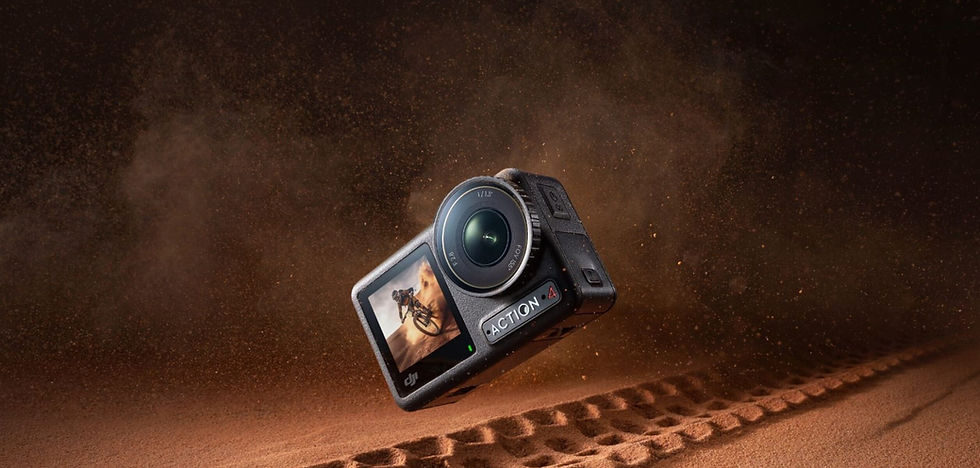
When you look at the current flagships, like the latest DJI Osmo Action series, you see a focus on this 10-bit color depth and high-dynamic-range (HDR) performance. This data-rich footage allows for professional color grading in post-production, giving the creator total control over the mood and aesthetic of the final film. You are no longer "stuck" with the look the camera gives you; you have a professional-grade raw file that can be molded to fit your unique artistic vision.
Resolution vs. Frame Rate: The 8K Debate
In 2026, we are seeing a massive push toward 8K resolution and hyper-high frame rates like 400fps for super-slow motion. While these numbers look great on a spec sheet, it is important to understand the trade-offs. 8K video generates enormous file sizes and requires significant processing power to edit. For many creators, a perfectly stabilized 4K image at 60fps is actually the "sweet spot" for most content, offering a balance of clarity and manageable workflow.
However, the extra resolution of 8K is invaluable for "reframing." It allows you to crop into the image to get a "close-up" shot without losing any detail on a standard 4K screen. This effectively turns a single wide-angle lens into a multi-camera setup. High frame rates, on the other hand, are the secret to "cinematic" action. Slowing down a fast-moving subject—like a mountain bike jump or a splashing wave—allows the audience to see details that the human eye usually misses. It adds a layer of drama and texture that elevates a simple clip into a piece of visual art.
The Hybrid Ecosystem: When Action Meets Traditional Vlogging
While action cameras are more capable than ever, they often exist as part of a larger gear ecosystem. For many creators, the best vlogging camera is actually a hybrid setup. This might include a large-sensor mirrorless camera for planned studio segments and an action unit for the "run-and-gun" field work. The challenge is ensuring that the footage from these different devices looks cohesive when edited together. This is achieved through consistent color profiles and a shared understanding of how to use each tool for its specific strength.
A hybrid approach allows you to scale your production value according to the situation. If you are doing a deep-dive educational video, the shallow depth of field of a full-frame camera provides the authority and focus needed. If you are doing a travel montage, the agility and wide perspective of an action cam provide the energy. The modern creator is a "multi-tool" operator, selecting the specific instrument that matches the emotional beat of the story.
Mirrorless vs. Action: Choosing Your Primary Perspective
The decision between a traditional mirrorless setup and an action-focused kit often comes down to "subjectivity." A mirrorless camera, with its interchangeable lenses, is an "objective" tool—it looks at the world with a specific, curated focus. An action camera is a "subjective" tool—it looks with the creator, moving as they move and seeing what they see. For personal brands and vlogs, the subjective perspective is often more powerful because it builds a stronger sense of shared experience with the audience.
However, we are also seeing the rise of "pocket gimbals" that provide a third path. These devices offer the mechanical stabilization of a professional rig in a body that fits in a pocket. They are the ultimate "middle ground" for creators who want the smoothness of a cinematic crane but the portability of a smartphone. In 2026, your "primary" camera might not be the biggest one you own, but the one that is most likely to be in your hand when the light hits the subject perfectly.
The Portability Factor in Modern Storytelling
We must not underestimate the physical toll of carrying gear. "Creator burnout" is often as much about the physical fatigue of lugging thirty pounds of equipment as it is about the mental stress of editing. The shift toward ultra-portable, rugged kits has extended the creative lifespan of many filmmakers. When your entire production studio fits in a small shoulder bag, you are more likely to head out for a sunrise shoot or take the extra hike to the hidden viewpoint.
Portability also enables a "stealth" approach to filmmaking. A large camera rig draws attention and can make people act unnaturally. A small, discreet action or vlogging camera allows you to blend into the environment, capturing candid moments and authentic interactions that would be impossible with a conspicuous setup. This "unfiltered" access is the currency of modern content; it is what makes a video feel like a real slice of life rather than a staged production.
Sound Architecture: The Unseen Foundation
If video is the body of your story, audio is the nervous system. You can have the most beautiful 4K footage in the world, but if the sound is thin, echoing, or wind-blasted, the viewer will click away within seconds. The internal microphones on most cameras are designed as a backup, not a primary source. To achieve professional results, you must use a dedicated microphone lavalier to place the capture point as close to the source of the sound as possible. This proximity ensures a high "signal-to-noise" ratio, making your voice the dominant force in the mix.
In 2026, wireless audio has reached a level of reliability that was previously reserved for high-budget television. Modern digital systems use encrypted, frequency-hopping technology to ensure that your signal stays rock-solid even in a city full of Wi-Fi interference. This "technical sovereignty" allows the creator to focus entirely on their performance, knowing that their voice is being captured with total clarity and no static or dropouts.
Why Built-in Audio Isn’t Enough for 2026 Standards
Built-in microphones are physically limited by their location. They are attached to the camera, which is often several feet away from the speaker. This distance allows the environment to creep in—the hum of an air conditioner, the roar of traffic, or the "roominess" of a large hall. Furthermore, most action and vlogging cameras are waterproof, which means their microphones are covered by a protective membrane that can make the audio sound "boxy" or muffled.
By using an external lavalier, you bypass these physical limitations. You move the sensor to within inches of the mouth, where the sound pressure is highest. This creates an intimacy and "presence" that built-in mics simply cannot replicate. It creates a psychological sense of trust with the audience; when you sound like you are speaking directly into the viewer's ear, they are more likely to believe and engage with what you are saying.
Strategic Mic Placement for Action and Vlogs
In high-action environments, mic placement is a specific craft. If you are mountain biking or skiing, you can't just clip a mic to your collar and hope for the best; the wind will ruin the take. Professionals hide the mic under a layer of clothing or use specialized "deadcat" wind muffs to break up the air before it hits the capsule. They might also use a "dual-system" approach, recording a safety track at a lower volume to ensure that a sudden shout or an unexpected noise doesn't "clip" and ruin the recording.
For everyday vlogging, the goal is "invisibility." You want the technology to disappear so the conversation feels genuine. Small, magnetic clips and ultra-light transmitters have made this easier than ever. You can hide the mic behind a lapel or even under a thin shirt, and with modern AI-driven noise reduction, the resulting audio will sound as clean as a studio broadcast. It’s about creating a "frictionless" environment where the gear supports the story without being a distraction.
The Geometry of Stillness: Beyond Digital Stabilization
Stability is the hallmark of professional video. When the camera shakes, the viewer's brain has to work harder to process the image, leading to a subtle but real sense of fatigue. Most modern cameras use Electronic Image Stabilization (EIS), which crops into the image and uses AI to shift the frame around. While this is incredibly effective for action sports, it has its limits—specifically in low light, where it can cause a "warping" effect. To achieve true, cinematic fluidity, many professionals still rely on a dedicated phone gimbal or a motorized handheld stabilizer.
Mechanical stabilization provides a level of precision that software alone cannot match. It allows for "robotic" pans and tilts that feel intentional and grand. It also allows you to perform "parallax" shots, where you circle a subject while keeping them centered, creating a powerful sense of 3D depth. In 2026, the best setups use a combination of both—the "coarse" stabilization of a motorized gimbal and the "fine" stabilization of the camera's internal software.
Mechanical vs. Digital: Understanding the Stabilization Trade-off
Digital stabilization is a miracle of modern math. It allows a tiny camera to look like it’s floating on a cloud. However, it requires a "crop," meaning you lose some of your wide-angle perspective. It also doesn't handle "rolling shutter" (the jello-like distortion of moving objects) as well as a mechanical system. For high-speed action where you need to be light and mobile, digital is the winner. For "cinematic" vlogging where the quality of the motion is the primary goal, mechanical is still the gold standard.
A motorized stabilizer also acts as a "smart handle." It gives you remote control over the camera's zoom and focus, and it can even track a subject automatically as they move around a room. This "automated cinematographer" capability is vital for solo creators who are both the talent and the crew. It allows you to move naturally and interact with your environment while the gear handles the technical job of keeping you in the frame and in focus.
Integrating Mobile Devices into Your Professional Workflow
In 2026, your smartphone is often the hub of your entire production. It acts as a monitor, a remote control, and a high-speed link to the cloud. Most modern stabilizers and cameras are designed to work in a "one-tap" ecosystem with your phone. This integration allows for a incredibly fast workflow—you can film a segment, it automatically syncs to your phone, and you can have a "rough cut" ready for social media before you’ve even left the location.
This "connected" workflow is what allows modern creators to stay ahead of the curve. You aren't just making a video; you are managing a digital pipeline. The ability to monitor your "levels"—both audio and visual—on a larger smartphone screen ensures that you don't make mistakes that you'll regret in the editing room. It’s about building a "feedback loop" where you can see exactly what the audience will see, in real-time, allowing you to make adjustments on the fly and get the perfect take every time.
Preparing for the Future of Immersive Media
As we look toward the final years of this decade, the way we consume content is changing. We are moving away from flat screens and toward "spatial audio" and immersive 3D environments. This means the way we record our world must also evolve. We are seeing a rise in "ambisonic" microphones that capture sound in 360 degrees and cameras that record with a wider field of view to support virtual reality and augmented reality platforms. The best creators are those who are already thinking about how their content will "live" in these new digital spaces.
This doesn't mean you need to buy a whole new kit every year. It means you should invest in a "future-proof" foundation. This means prioritizing high-bitrate recording, 10-bit color, and robust internal audio specs. The gear you buy today should be a bridge to the future, providing a library of high-quality raw data that can be re-purposed as new consumption technologies emerge. It’s about building a digital legacy that will remain relevant and beautiful for years to come.
Spatial Audio and 360-Degree Narrative
Spatial audio is the final frontier of immersion. It allows the listener to hear where a sound is coming from in 3D space—above, below, or behind them. For travel vloggers, this means the viewer can actually "hear" the market sounds around them or the wind whistling through the mountains. To achieve this, we are seeing the rise of wireless systems that can sync multiple microphones and "place" them in a 3D soundscape during post-production.
The narrative also becomes more "choice-driven." 360-degree cameras allow the viewer to look around and explore the scene at their own pace. While this is a different type of storytelling than a traditional "cut" video, it offers a level of agency that is incredibly compelling for certain audiences. The key is to use these tools with intent—to show a world that is worth exploring in every direction, rather than just using the tech as a gimmick.
AI-Driven Editing and Automated Cinematography
The "invisible hand" of AI is already present in our stabilization and noise reduction, but the next step is "narrative intelligence." We are starting to see software that can identify the "highlights" in a three-hour shoot and automatically assemble a rough cut based on the emotional peaks of the audio and the visual action. This doesn't replace the editor; it removes the "boring" work of sorting through thousands of clips, allowing the human to focus on the high-level pacing and storytelling.
Automated cinematography will also allow for even more complex shots. Imagine a stabilizer that knows exactly when to "whip pan" to a new subject based on the dialogue, or a camera that automatically adjusts its exposure and focus to match the "mood" of the scene. The technology is becoming more "aware" of the story being told, shifting from a passive recording device to an active creative partner. The future of content belongs to those who can master this partnership, leveraging the power of the machine to enhance the unique vision of the human.
Building a professional content library is a marathon, not a sprint. It requires a commitment to quality that goes beyond just buying the latest gadgets. It’s about a deep understanding of the relationship between sight, sound, and motion. When you finally hit that "perfect" combination—a clear, intimate voice over a smoothly gliding, high-resolution visual—the effect is undeniable. You are no longer just "making a video"; you are creating a window into your world that is clear, stable, and deeply resonant. The confidence that comes from knowing your gear will perform in any environment allows you to take bigger creative risks and tell more meaningful stories. As you head out to capture your next project, remember that the most important element isn't the resolution of your sensor, but the clarity of your voice and the stability of your vision.


Comments